
Monastic Rhythms
Most of us haven’t walked away from God. We’ve just become incredibly busy. Our days are full of work, family, responsibilities, notifications, appointments, entertainment, ministry, errands, and noise.
Even our time with God can become one more thing to fit into an already crowded schedule. We pray when we can. We read Scripture when we have time. We try to squeeze devotion into whatever space is left. And somewhere along the way, without meaning to, we can begin fitting God around our lives instead of building our lives around God. That’s part of what monastic rhythms can help us recover.
This isn’t about becoming a monk, escaping normal life, or pretending responsibilities don’t matter. It’s about rediscovering ancient Christian practices that help us slow down, become attentive to God, and create intentional space for prayer, Scripture, silence, rest, and simple devotion.
For centuries, Christians have recognized that our souls need rhythms. We need moments where we stop producing. Stop scrolling. Stop solving. Stop filling every quiet space. And simply become present to the God who is already present to us.
Monastic rhythms remind us that prayer does not have to be fitted around the edges of our day. Our day can begin to be shaped around prayer. They remind us that silence is not empty. Rest is not wasted. Solitude is not isolation. And being with God is not preparation for the “real” work of life. Being with Him is the foundation from which everything else is meant to flow.
Maybe what many of us have been missing isn’t another Bible study, another podcast, another conference, or another thing to accomplish. Maybe we need to recover simple devotion. A slower life. A quieter soul. A heart that can once again say: “God, I’m here. I just want to walk with You.”
What have we been missing?
My experience: Monday
Arriving wasn’t the easiest by any means. Opie had been sick the entire night, and in trying to give Kristen as much rest as I could, I took it as my night. I got less than two hours of sleep total. We woke up making plans for where Kristen would work so someone could watch him during the day since daycare wasn’t an option. I was going to take Anna to daycare and then get the truck ready for the three-hour backroad trip. Just as we had it all settled, Kristen found out she had jury duty that day.
I genuinely postured myself that I probably wasn’t going on the trip because I needed to be home to help.
Looking back, I think I had been getting tired for five years.
In May of 2021, I stepped into a dying church with the hope of helping rehabilitate it and somehow seeing God breathe life back into it. Four months later, in September, Kristen and I got married. The church began growing faster than any of us expected, and by October of 2022 we had moved to two services.
At the same time, Kristen and I were struggling to have our first child. Eventually we discovered the medical issue was with me, and while the doctor never actually said, “It’s not going to happen,” everything he said felt like he was preparing us for that reality. We began the process toward IVF, and the very week we were signing the financial paperwork, we found out we were pregnant.
I became a dad for the first time at 42. Then almost immediately, we found out Opie was coming.
All the while, church life kept moving. There were ugly staff transitions. People I loved left the church. The church kept growing. We hired new staff. There were problems to solve, people to care for, sermons to preach, decisions to make, and another Sunday always coming.
Somewhere in the middle of all of it, I nearly broke.
I reached a point mentally and emotionally where I knew I wasn’t okay and eventually went on antidepressants. At the same time, I began deconstructing—not my faith in Jesus, but much of what I had been taught about ministry and what faithfulness in ministry was supposed to look like. I began realizing that some relationships and ministry environments I deeply loved had also been deeply unhealthy for me. Walking away from people you love because you realize you can no longer remain healthy around them carries its own kind of grief.
And through almost all of it, I just kept moving.
Another Sunday. Another decision. Another crisis. Another person who needed something. Another sermon. Another meeting. Another season of growth. Another transition.
Marriage. Babies. Church. Leadership. Healing. Grief. Growth. Change.
There had rarely been a moment to stop long enough to ask what all of it had done to me.
So when I say I was tired, I don’t mean I needed a good night of sleep.
I mean something in me had been running for five years without ever fully coming to rest.
I wasn’t just tired. I was weary.
Kristen is an absolute answer to prayer. She truly is everything I never knew I needed to pray for. She was adamant about me going on the trip because I needed a break—for church, yes, but for her and the kids also.
I had planned on still taking two meetings at the church before I left because Mondays set the tone for the upcoming weekend and help ensure everything is moving in the right direction.
Belinda jumped into action to take care of Opie, Mom and Dad took Max, I told the staff I wasn’t going to be at the meetings, Kristen wasn’t sure if we would see each other before I left because of jury duty—and I left.
I ran some errands to waste time so I wouldn’t go into the office, and by the time I was done it was 11am, exactly when I needed to depart and get on the road.
I usually find the shortest route I can and drive faster than I should so I’m not on the road as long. This time, however, I found the route that was almost entirely backroads. I wanted to take my time and ease into this monastic retreat of silence.
Admittedly, I wasn’t sure what I was getting myself into.
Who was going to be here? What was it going to entail? Would I even be able to stay quiet the entire time?
I’m a control freak by nature, so not having those small details at least thought through beforehand proved problematic on the drive. There were several moments of anxiety and nervousness as I debated the entire thing. Certainly there was another option, but in the middle of all the unknown, I knew one thing for certain: I was exhausted.
The drive itself was peaceful. Tennessee and Kentucky backroads, farmhouses and their surrounding farms. Hills and turns seemingly everywhere, with small towns tucked between them.
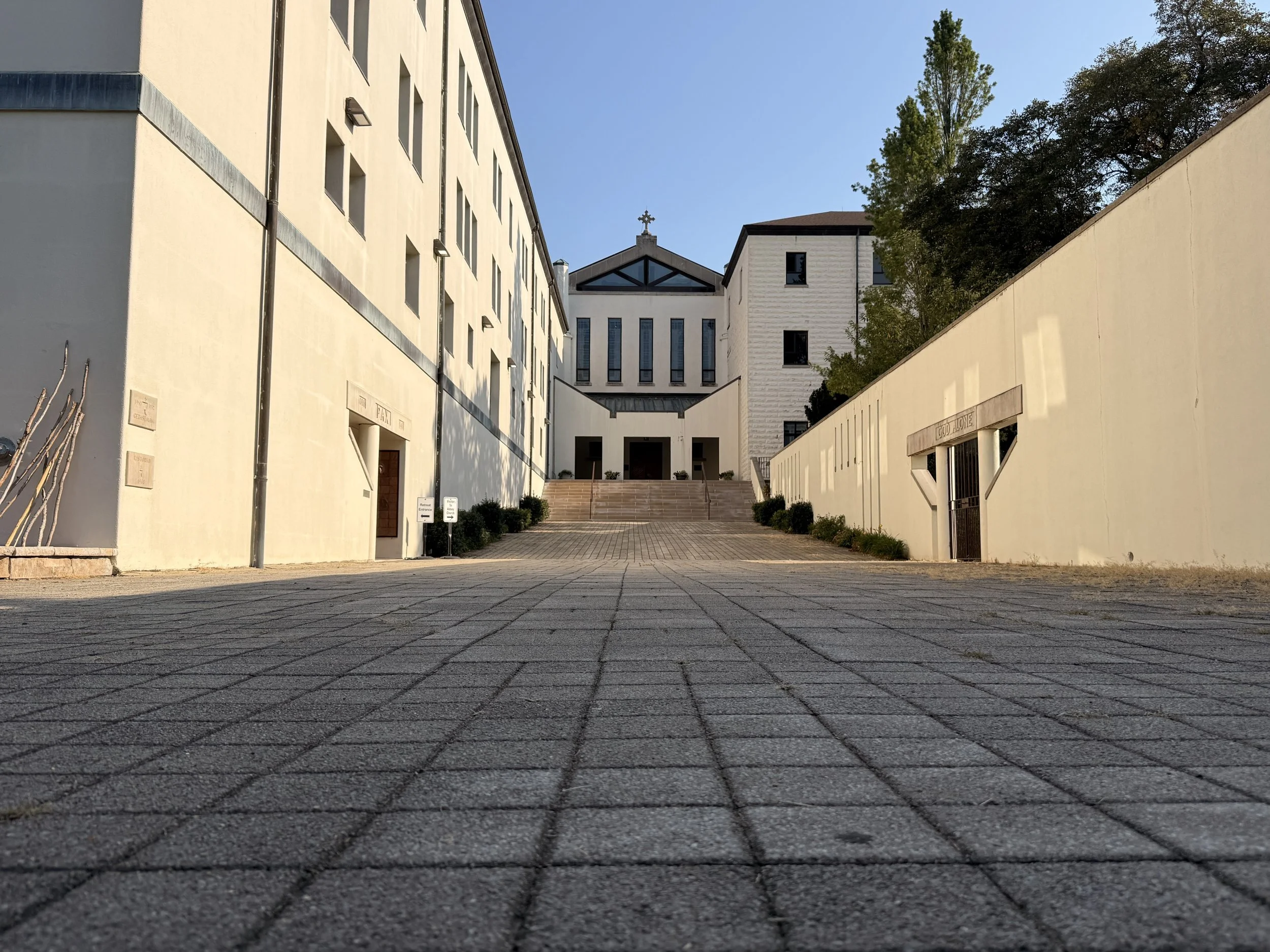
I finally landed at the monastery, and pictures don’t do it justice.
Immaculately kept grounds. Mature trees placed throughout the entryway. A novel little cemetery near the front walkway to the guesthouse. Random chairs beneath trees for retreatants to sit quietly and escape the noise of life.
It was impressive to see something in the middle of nothing and to be somewhere in the middle of nowhere.
Exiting the truck, it was noticeable how palpable the atmosphere was. Calm. Not busy. Peaceful and peace-filled.
I wasn’t sure where to go, and I didn’t want to act out of order by wandering somewhere I wasn’t supposed to be, so I made my way to the gift shop. They make chocolates and fruitcakes as Trappists during the hours they aren’t praying or taking care of guests during the day.
I entered the gift shop and simply asked, “Where am I supposed to be?” The ladies pointed me in the direction of the four-story guesthouse that looks somewhat like a well-kept hotel across from what appeared to be a high-walled garden.
It was increasingly noticeable how peaceful it was. So either I was that exhausted and searching for respite, or there was something about this place that has stood the test of time.
I think the only way I can put into words what I felt was this: Is this the embodiment of, “Come all who are weary and I will give you rest”?
I crossed a threshold on the property leading to the guesthouse after following the ladies’ directions. A sign read, “Silence after this point.” It’s evident they have a plan in place even for travelers who are clueless as to what they’re getting themselves into.
I walked through the front door of the guesthouse and was greeted by another lady who found which room I was in. No computer for check-in, just a simple piece of paper with retreatants’ names on it. She handed me a key.
I told her I wasn’t sure where to go or what to do since this was my first time, and she directed me toward a set of stairs or an elevator. I told her I’d take the stairs. She joked that a lot of people prefer to do so and then followed it with, “I’ll keep my eye on you.” I laughed and made my way upstairs to find my floor and room.
I walked into a modest, dorm-style room with a twin bed, desk and chair, a bedside lamp, and a place to put my clothes. The bathroom was similar—nothing extravagant, but everything I would need. It wasn’t excessive. No TV. No phone. No bells and whistles. Just a room with a bed and a bathroom.
I went back to my truck to retrieve my luggage, got back to the room, and crawled into bed. It was 3pm and supper was at 6, so I set my alarm for 5:30.
It was the first of several realizations on the property of how spent I actually was. Not just from the drive. Not tired from any one particular “thing.” I was drained and empty—emotionally, mentally, physically, and spiritually exhausted. I looked into the bathroom mirror under an unforgiving vanity light and saw a face that nearly appeared unrecognizable. I’m not sure I’ve ever known this level of tired before. Maybe Kristen was right the entire time about my need to get away and disconnect.
I slept soundly until my alarm woke me up, got dressed, and headed downstairs—still unsure of instructions or protocols, but that seemed to somewhat describe everyone, or at least that’s how it appeared to me.
We all made small decisions that each person followed along with and eventually found the food line leading into the dining hall, where we ate in silence—each respecting both the rules we were still unsure of and the people around us whom we didn’t know.
Following dinner, we had a 6:30 introductory meeting/service with Father Carlos who has been on the property for 40 years. He gave us the details we didn’t know and then gave us the inspiration for why we were here: To meet the living God who loves us. Not merely the God of our doctrines and denominations. Not the God found only within Bible knowledge, but the God who wants to be real to us and often can’t be heard outside of silence. It was refreshing to finally get some semblance of awareness of why I was here.
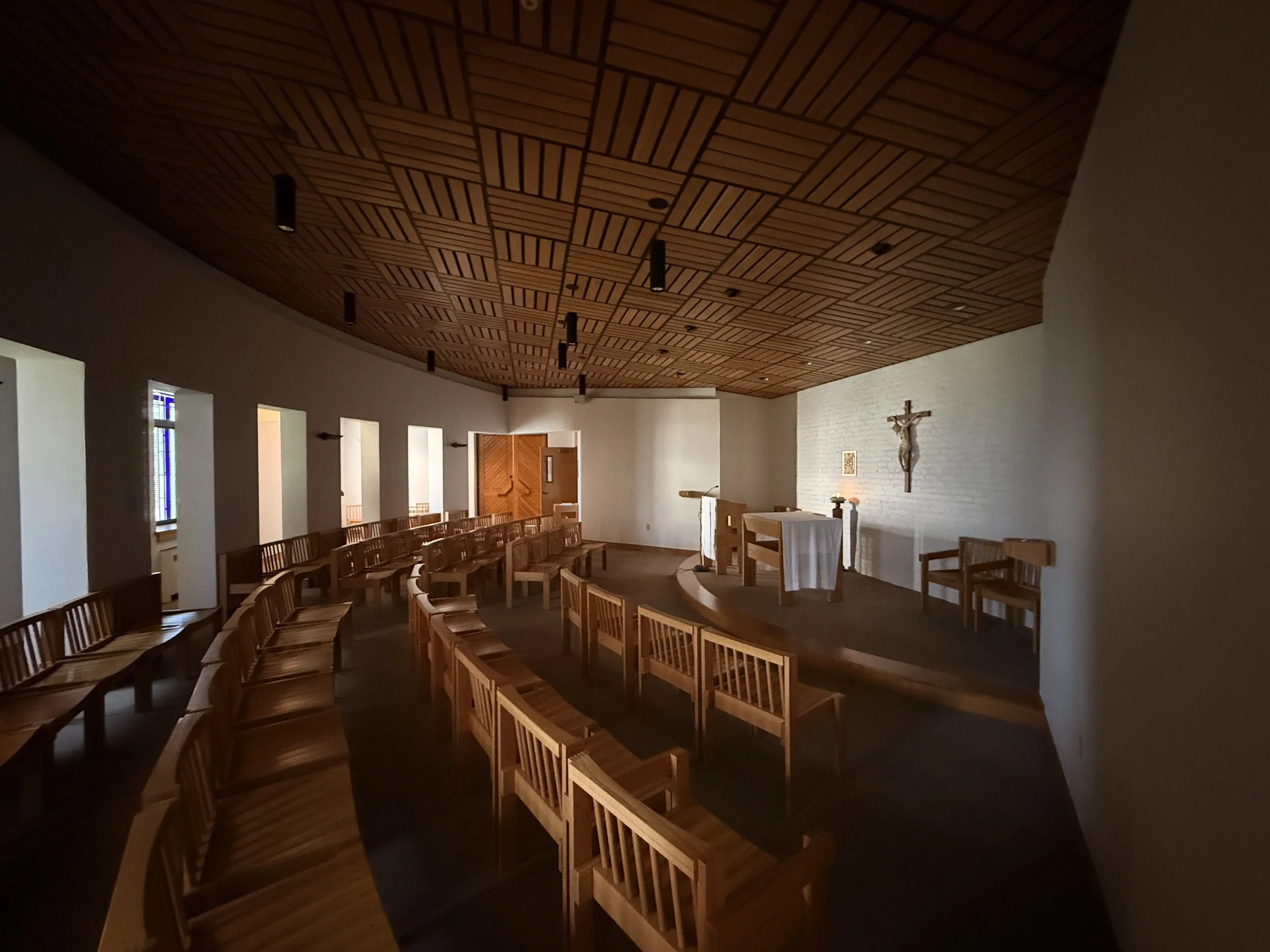
Following the talk, it was time for Compline, the final prayer and worship moment the monks honor for the completion of the day. We were invited to attend and watch from a space set aside in the church.
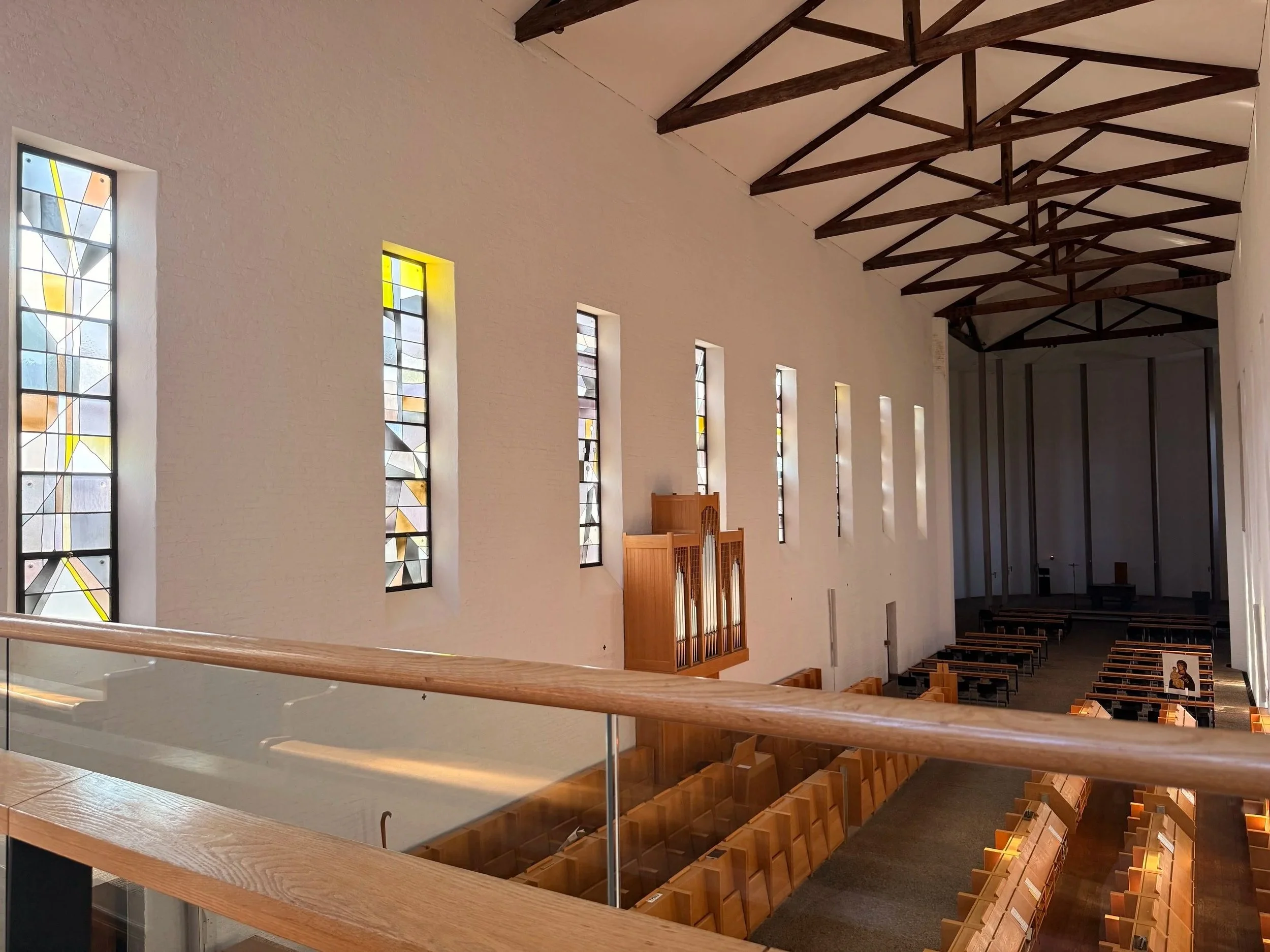
Probably close to 150–200 feet long, maybe 50 feet wide, and 75 feet tall, it’s minimalist in appearance. Not the architectural picture of a cathedral I had imagined, but rather white walls, simple wooden beams holding up the white roof, modest chairs and seating, and a stone floor. It’s beautiful. And I fight the urge to figure out how I would improve it if it were Salem or if I were in charge. That becomes the first of several internal fights I feel like I may have as I focus on being quiet—not just from talking with others, but from talking with myself. I’m here to commune and abide with God.
I enjoyed watching the monks come in and having the opportunity to observe them worship. Modeling the pattern of the church itself, everything is very modest and minimalist. Just a chorus of voices following songs drafted from Scripture—certainly not the noise of the latest radio worship created for charts and appeasement of the masses. They are singing to honor the One who gave them the day and thanking Him for its completion.
I filed in line with everyone else, still not sure exactly what I was doing, and the Abbot blessed me alongside everyone else. I wasn’t sure whether I should bow, say thank you, or do something else, but I fought the urge to begin asking questions—everything from what we were singing to how they kept the monstrous room cool with no visible HVAC.
Again, attempting to stay quiet even with myself. I made my way back to my room, got ready for bed, FaceTimed Kristen and the kids, and enjoyed speaking with someone—especially playing hide-and-seek with Anna over FaceTime.
Then I turned off my phone and the lights and went to sleep...for 15 hours.
My experience: Tuesday
I wouldn’t say I slept hard, but I woke up as I typically do—to roll over. I didn’t have to bounce between Kristen and Max, so there wasn’t the familiarity of home, but I made do hugging a pillow.
I knew I more than likely wasn’t going to participate in the monks’ prayer times that started at 3:15 and again around 5:45, at least not to start.
I feel like I have so many questions about their various routines, things I notice, etc., but I don’t want to bother them or be rude toward their way of life and connection with God. Maybe I’ll Google everything when I leave, but for the time being I’m simply in awe of their reverence and diligence in prayer and worship. The monastic life has an appeal to me. Seeing the simplicity of it all, watching them adhere to a life of prayer and service to the Lord—it feels like this should be the norm instead of something an outsider comes to visit.
We have so complicated life, and in doing so we’ve either:
A) watered down our process of devotion so it can fit within our schedule, or
B) made it a box to check in passing.
I think they have something right that so many of us, myself included, have made so wrong. Is this what Paul meant when he said it was better to remain single so you could devote yourself to the Lord? I’m not sure, and I wouldn’t trade Kristen or the kids for this, but there’s an appeal to being more monastic in life. There’s an appeal to normalizing a lifestyle of devotion more than what I’ve done. I’ve let myself become too busy. I’ve allowed myself to become cluttered. I’ve embraced the cares of this world and not even realized the detriment that came alongside it all. I’ve traded simple devotion that would appeal to my soul for “stuff.” No wonder I’m tired all the time.
I feel rather rested—I should hope so after 15 hours of sleep—to the point that maybe I will get up with the monks at 3:15 and go pray, inviting myself to partner with the Lord for the coming day before the rest of the world is awake. I got up and showered at 11, and by 11:30 I was out for a hike in nature. I probably should have looked at the available maps more than I did. I think I just wanted an adventure, and it felt freeing not having my cellphone with me to tether me to taking pictures ABOUT where I was, but rather spending the time being PART of where I was. I walked a few miles out and made my way back just in time for lunch at 12:30, which they refer to as dinner. After dinner, I came back to my room, which has become my little haven of rest, and took time to read my Bible. THIS is where things have begun weaving themselves together, and we have to go back to a moment last night before bed.
I didn’t read much last night, but one of the Psalms we sang with the monks was Psalm 91. As I was scrolling through my Bible to find it, I landed on Psalm 86, titled “Great Is Your Steadfast Love.” I was focusing on verse 11: “Teach me your way, O Lord, that I may walk in your truth; unite my heart to fear your name.” I was settling in on it mainly because it was already underlined and I had written a note beside it sometime ago that said: “I want to know You more than anything, to walk and talk with You.” My eyes fell, however, to verse 15: “But you, O Lord, are a God merciful and gracious, slow to anger and abounding in steadfast love and faithfulness.”
I’ve heard this before. I knew I had. It took me a moment to recognize it as the declaration God makes about Himself to Moses when He appears to meet with him. I haven’t wanted to use my phone to search things while reading my Bible, so I started flipping through pages and using the cross-references to see if I could hunt down where this originated. And I found it. Exodus 34, when Moses has to make two new tablets of stone. I had found it, and it didn’t leave me without something to meditate on.
Verse 5: “The Lord descended in the cloud and stood with him there, and proclaimed the name of the Lord.” Verse 6: “The Lord passed before him and proclaimed, ‘The Lord, the Lord, a God merciful and gracious, slow to anger and abounding in steadfast love and faithfulness...’”
A few things stood out.
First, “the Lord descended and stood with Moses”. I so want to meet with the Lord and see His goodness. To be trusted with His Word. To meet with Him face-to-face and speak to Him as a friend speaks to a friend. I’m so concerned about mistakes I’ve made and my consistent failings, and then I remembered: Moses was a murderer who literally hid the body of an Egyptian he had intentionally killed in the sand. He ran away when he realized he’d been discovered. THIS was the guy God came down and stood beside. THIS was the same person God called to His side. THIS was the individual God used to lead people, deliver people, and give people His Word. So yes, He is a God who is merciful and gracious, slow to anger and abounding in steadfast love.
He’s a God who loves His sons and daughters and wants to interact with them. He’s a God who wants to be near us and reveal Himself to us. He’s a God who doesn’t want to be far removed and isn’t sifting through those He can use, love, or approach based on their pasts and issues. He KNEW Moses’ past before He called Moses. AND THIS WAS BEFORE JESUS FULFILLED THE LAW!
So I spent the night meditating on that every time I woke up, reminding myself of those very words God declared about Himself and closing it with an inhale of:
“Abba...”
and an exhale of:
“I belong to You.”
After my walk and coming back to eat lunch, I spent time rereading the Exodus story to mine out any pieces I’d forgotten or hadn’t seen before. Then I took another nap before dinner. I wasn’t worn out from the hike. I’m still recovering and detoxing from the busyness of life that I’ve made into a habit.
After waking up for supper, I came back to my room to grab my laptop and began documenting all that had happened yesterday until it was getting close to time for evening Compline. I felt more comfortable in the balcony, where I could observe more instead of being in the throes of all the routines I still don’t quite understand. It seems those who are more Catholic fit better downstairs in the section nearest the monks and go forward to have the Abbot bless them with holy water.
I’ve come back to my room now and will spend more time in the Word, reading through Exodus in quiet and solitude, encountering the living God who loves me—the God who is merciful, gracious, slow to anger, and abounding in steadfast love. And maybe I’ll get up at 3:15 to go pray with the monks.
My experience: Wednesday
I didn’t get up in time for the 3:15 Vigils OR the 5:45 Lauds and Eucharist. I didn’t actually get up until close to 8, which was another 11 hours of sleep. I’ve missed breakfast both mornings thus far. Kristen will be upset with me because she wanted me to promise to eat three meals a day. In my defense, I did eat a protein bar each time I got up.
Anyway...
I saw on the map there was a location called “Stone House” on one of the trails, so I got ready and headed off for another adventure in silence, hoping I wouldn’t get lost but simultaneously wondering if it might happen. It’s so peaceful whether you’re on-site at the monastery or off on a trail in the woods.
As I was getting ready for bed last night, I decided to read some cards I discovered in the desk drawer from former retreatants. Reading their prayers, their discoveries of the Lord, and the love He offers was amazing. Several of them referenced the Song of Solomon in various writings, and it dawned on me that I hadn’t actually read through Song of Solomon in a while. It’s not necessarily my go-to book of the Bible like Psalms, Proverbs, or practically any other book. It’s probably right after Revelation for me.
As I read through it, however, it moved in my mind from simply a picture of Solomon and his bride to a picture of the heart of Jesus toward each of us. I found delight in reading how much He really does love me. Chapter 7, verse 10 specifically stopped me in my tracks: “I am my beloved’s, and his desire is for me.”
So much so that I began writing in my Bible: “I’ve spent so much time trying to prove my worth and value that I’ve overlooked that He has ALWAYS longed for me. He has always desired me. My striving to be ‘worthy’ has caused an insecurity within me that has attempted to eat away at the knowledge of simple devotion based on the reality that I have always been loved.”
So I made that my reminder on my walk this morning as I adventured through the trails.
I can’t say I was praying the entire time as much as I can say I wasn’t being busy the entire time. I just walked. And when I felt my mind wandering too far—usually navigating what I would do if a bear came out of the woods...Could I climb a tree fast enough? Could I make myself big enough to scare it away? Could I fight it off? Yes, I genuinely wondered if I could attempt it.
Eventually I’d realize I had gotten off course from my diligent studies of doing absolutely nothing but walking and would gently remind myself:
“I am my beloved’s, and His desire is for me.”
I love the thought of that.
I know God is love. Not that He merely offers His love, but that He IS love. But somewhere in the recesses of my mind and heart, I put away the thought that God actually desires me. That He yearns to walk with me through the woods and through my mental ramblings about fighting off bears should they dare cross my intimidating path. I’ve spent 25 years now attempting to DO for God through ministry, and I can’t remember many times I have ever been settled in the truth that I just have to BE who He has always wanted me to be: A desired and beloved son.
I’ve often hated silence because in it my inadequacies and failures scream constantly. But here, in the quiet, I’m meeting a side of God I never knew wanted to encounter me. And I’ve preached it for years, but stumbling exhausted into this retreat, I’ve finally found that He desires me. Not for what I can do for Him or for His Kingdom. He wants to walk beside me and be included in my goings and doings. That is an exhale I’ve been waiting to have for quite some time.
On my walk, I think I passed the Abbot of the monastery. I don’t know any of their names, but as we passed each other we had an entire conversation with a mutual smile and nod. I wonder if they are aware of how blessed they are. I wonder if they know the envy those like me carry deep within us for the simplicity of serving the Lord they have the opportunity to live out. There’s a side of me that wants to know how I can bring a piece of this monastic life home with me. To sit in silence with the Lord, unbothered by the busyness of life careening by. There’s work to be done in the Kingdom without a doubt, but somehow they’ve made their service to Him uncluttered.
I’m jealous of them. Not because their life is easy by any means, but because they’ve made the hard decisions not hard at all by choosing Him and His presence over everything else. We have our cellphones, Wi-Fi, our big screen TVs, hobbies, lists, tasks, and doings, and yet most people I meet haven’t found simple devotion like this. I do wonder if there’s a way to bring this home with me.
At the very least, I’m enjoying this break from it all, and on my walk I pondered how I could bring at least the elders and some deacons with me another time. Let them steal away from the busyness of it all in their lives and find some rest for their souls. As long as they aren’t like the three elderly ladies who are also here whom I’ve run into on numerous occasions who apparently have no volume control. Literally as I’m typing this.
But for the most part, everyone respects the silent quest each person is on for quiet time with the Lord.
That’s enough for now. It’s not even 11am, and I’m looking forward to more moments to steal away with Jesus and His Word.
Midday today was the first moment I began to struggle with what to do. I’m so used to filling my time with things. Stuff. Noise. Doings. I wasn’t quite sure what to do, so I contemplated whether I should leave early. Did I get all that I was supposed to get?
I chose to take a nap, which—between the time in the Word, the detachment from “noise,” and observing the monks—has been one of the most meaningful and fulfilling ingredients of this entire retreat. I think I was posturing myself with the thought, “Now that I’m physically not exhausted, I can jump back into life full swing.” I’m not sure I was factoring in the spiritual exhaustion I’ve had with that train of thought.
I woke up from my nap, grabbed my Bible, and found a quiet place in the chapel to begin reading more. I had already finished the book of Exodus and found nugget upon nugget regarding the call of ministry, but I felt led to go to Paul’s pastoral letters.
The ongoing theme of godliness became evident. For those called to ministry, godliness is something we are called to live in and live from. Over and over, Paul reminds people to base their lives in the pursuit of godliness, contentment, and love—building the Kingdom and operating within the Kingdom from those things. It feels like something that’s either been missed or at least not taken notice of. Be “good”? Yes. Be “wary of sin”? Yes. But strive for godliness. Not something consciously pushed aside, but perhaps inadvertently overlooked.
Maybe that’s what these monks have found. A quiet life seeking godliness has cut out the noise from their lives. It seems to appear in everything I’m encountering here. The worship and prayer services? Simple and godly. The amenities? Simple and godly. The kindness toward others? Simple and godly. The food? Not much flavor, if I’m being honest. But it’s simple and without trying to be something it was never intended to be—sustenance for the next moment. So, yes. Simple and godly.
After dinner I ran upstairs to get my laptop and Bible. No one had taken up the coveted seating area outside the main cafeteria, lined with a short wall guarded by flowers of all sorts and bird feeders. The birds own this part of the garden, and I can see why retreatants quietly fight for their turn to sit out here. It’s west-facing, so the sun is going down over the manicured walkway with mature trees, statues of apostles and saints, and then a six-foot stone wall keeping the clutter of the world out. But while we remain silent for each other’s sake and our own, the birds sing.
I wonder what the birds in Eden sounded like when Adam sat quietly and just listened. Obviously, there wasn’t the distant rumble of cars traveling up and down the road outside the garden. But if I choose to calm myself, those noises fade into the distance and all that’s heard are the songs of numerous birds and their happy flittering around the feeders.
This is nice. I’m glad I didn’t listen to myself and leave early. My soul needs and needed this. And it needs it more often than maybe I realize. The birds don’t seem bothered by the rustling of cars up and down the road. Maybe neither should I. In the cafeteria there are small quotes and Bible verses framed and placed around the room. One that caught my eye was: “Before we were searching for God, God was searching for us.”
Maybe that’s what this is all about. Not the trek to go find God somewhere three hours from home, but to stop and turn around, recognizing He has been walking after me this entire time, hoping I would stop long enough to notice Him and invite Him along the way.
Maybe I’ll capture the wherewithal to ask Him to lead...and I’ll walk with Him.
My experience: Thursday
I had the hardest time sleeping last night—more than likely because of the accumulation of 11–15 hours of sleep at night plus two- or three-hour naps during the day. It sounds excessive when I type that out, but looking over the past five years, I know it was needed to recoup and start fresh.
Some of my mind was wandering toward conversations I wanted to have with people. Some bounced back and forth between Scriptures I’ve been meditating on. Some was just random thoughts that fluttered past my consciousness like the butterflies outside during my walk yesterday that seemed to be racing me down the trail.
I continued forcing myself back to my breathing:
“Abba...” on the inhale.
“I belong to You...” on the exhale.
Or:
“Yah...” inhale.
“Weh...” exhale.
I alternated between the two.
I think perhaps part of my difficulty sleeping was my desire to finally get up at 3:15 with the monks for their morning prayer. I was excited to watch and learn from this monastic way. I wasn’t sure what to expect. Honestly, I think I was anticipating some burning-bush moment as I entered the church. This time I sat on the ground floor with the monks instead of in the balcony where I could perch, join in the parts I understood, and abstain from the others. I entered the cavernous church, and what stood out to me was the quiet and stillness. I know God is everywhere. That’s simple theology. But it was almost like He was waiting.
I took my seat expectantly, my eyes darting back and forth looking for the ignition of the “bush” somewhere in the room and hoping I would be near it. The monks filed in slowly. Not with haste, but in a manner that simply communicated: “This is what we do.”
We began the liturgy of songs and Psalms. I’m still attempting to track where we are in the small booklet available for guests to follow along. After about 45 minutes, we were done. The monks finished, filed out, and went back to bed. I’m assuming bed. There was no bush. There was no burning. There was no wave of emotion overtaking everyone. The room was silent again. And what filled my heart was watching their simple devotion. Simple devotion to a God who is real and waiting on us. Even if He doesn’t speak, we still make the habit of going to meet with Him and reading what He has already said about our upcoming day, moment, season, or situation.
There was no Jacob/Israel moment of limping away forever marked and changed. It was simply the full culmination of: “God, I’m here for You before the day begins. I’m here for You tired. I’m here for You weary. I’m here for You with unbrushed teeth. I’m here for You with a heart that knows You’re here, and I want You to know I want You more than anything—even my sleep.”
I wasn’t perplexed by this adjustment to my expectations. Instead, it gave me more to think about as I walked back to my room, crawled into bed, laid there in the dark, and added “simple devotion” to the bouncing thoughts in my head.
I’ve experienced a lot of mountaintop moments and highlights with God and His presence. But I’m beginning to gather that I’ve allowed busyness to become my focal point so I don’t have to deal with the pain and trauma of the past. And what I’ve missed all along—what would undoubtedly help deal with that pain and trauma—is simple devotion. “God, I’m here. I’m here with all my baggage this time because it’s pressing on me. Or maybe I’m bagless today. But I’m here. I just want to walk with You.”
We have so complicated things and somehow missed the words we quote so easily: “Come all who are weary and I will give you rest.”
So I laid back down, attempted to quiet myself, fought with myself to actually get quiet, wrote down questions I wanted to ask the monks during the daytime... and eventually fell asleep.
I genuinely feel full. Emotionally. Mentally. Physically. Spiritually. My soul has found rest in this place. I am definitely starting to miss Kristen and the kids, more than normal, so I’m going to see if I can wait until Father Carlos is in his office to tell him thank you and give him a hug. This has been such a Sabbath for me that I’m starting to lose words to describe it. I just know it has been a nonstop God moment. I’m not sure what all the rooms are decorated with, but beside my bed is a picture of Jesus with an open book that says: “I am the living bread. Come to me, you who labor and are burdened, and I will refresh you.” There could not have been a more perfect picture beside my bed as I rested this week. I’m praying about how to make this an annual retreat for the elders and some deacons at the church. I want others to experience the solace and joy that have filled my heart. I know this is a mountaintop moment. Most retreats and conferences tend to be. But somehow, someway, I want to introduce monastic rhythms into my life.
Kristen needs that from me.
Anna and Opie need that example from me.
Salem needs that from me.
I love that the monks here have not fitted prayer around their day. Their day is fitted around prayer. I deeply desire that type of walk with the Lord. It’s 1pm. I planned on staying until tomorrow morning. But it’s time to go home.
It’s time to take the nuggets of what I hope and pray will have forever marked me and implement them back home.
This will not be my last time at the Abbey of Gethsemane.
AN ANCIENT RHYTHM FOR A DISTRACTED WORLD
Most of us have learned to fit God into our lives. We pray when we have time. We read Scripture when the morning isn't too rushed. We worship once a week. We hurry from one responsibility to another, carrying phones that make us available to everyone at almost every moment.
The monks at the Abbey of Gethsemani have chosen a radically different rhythm.
For generations, Trappist monks have structured their days around a simple conviction: our lives should be ordered around the presence of God rather than trying to fit God into lives that are already full.
Their days are intentionally simple. Prayer. Scripture. Work. Meals. Community. Silence. Rest. Then prayer again. Seven times every day, whatever they are doing stops. A bell rings. They leave their work and gather to pray.
The practice is called the Liturgy of the Hours or Divine Office. St. Benedict called it the Opus Dei—the "work of God." Its backbone is the Psalms, prayed and sung repeatedly until the entire Psalter has become part of the rhythm of life.
The point isn't that God needs to hear from us seven times a day. We need to remember Him seven times a day.
THE SEVEN HOURS OF PRAYER
VIGILS — 3:15 AM
Wake up. Watch. Listen.
Long before sunrise, while the world is still asleep, the monks gather for the first prayer of the day. Vigils carries the biblical idea of watchfulness—waiting expectantly for Christ and remembering that the coming day belongs to God before it belongs to us. The darkness itself becomes part of the prayer.
Before emails.
Before work.
Before responsibilities.
Before anyone needs anything from us.
God is already here.
LAUDS — 5:45 AM
Begin the day with praise.
As morning arrives, the community gathers again. The name Lauds comes from the idea of praise. Rather than beginning the day with news, notifications, responsibilities, or anxiety, the monks begin by turning their attention toward God.
The question isn't first, What do I need to accomplish today?
It is: Who is God, and how can I receive this day from Him?
TERCE — 7:30 AM
Consecrate the work ahead.
Terce traditionally marks the third hour of the day. Morning has begun. Work is waiting. Responsibilities are calling.
So they stop again.
Before giving themselves fully to their labor, they remember that their work also belongs to God. Then they return to it.
Prayer isn't an escape from ordinary life. Prayer changes the way ordinary life is lived.
SEXT — 12:15 PM
Stop in the middle.
By midday, the morning is behind them and there is still more day ahead. So the bell rings again. Work stops. They gather. They pray.
Sext teaches something our hurried culture desperately needs to remember: Not everything depends on us.
There is work that could continue. There are tasks that could be finished. But for a few moments, productivity gives way to presence.
Then they eat. Then they return to life.
NONE — 2:15 PM
Return your attention to God.
None—traditionally pronounced roughly like "known"—marks the mid-afternoon. This may be one of the most ordinary prayer times of the day, and perhaps that is precisely its gift. Nothing dramatic has to happen. God doesn't have to give a revelation.
You simply stop again and remember: I am still His. He is still here. This day still belongs to Him.
Then you continue.
VESPERS — 5:30 PM
Receive the evening with gratitude.
As work winds down and evening begins, the community gathers again. Vespers is evening prayer.
The day's accomplishments, disappointments, conversations, frustrations, joys and unfinished work are brought before God. Instead of carrying everything from the day into the night, there is an opportunity to release it.
Thank You for this day.
Forgive what needs forgiving.
Receive what I could not finish.
Everything belongs to You.
COMPLINE — 7:30 PM
Release the day and rest.
The final prayer is Compline, from a word associated with completion. The day is finished. There is nothing else to accomplish. The monks gather one final time to pray before entering the deep silence of the night. Then they go to their rooms. Tomorrow, God willing, they will rise and begin again.
Compline teaches us something many of us have forgotten: Sleep itself can become an act of trust. I have done what I could today.
God remains awake. I do not have to.
MORE THAN SEVEN PRAYER SERVICES
The seven Hours are only one part of the Trappist rhythm. Between them is a remarkably ordinary life.
Silence.
Trappists do not actually take a "vow of silence." Instead, they intentionally cultivate an atmosphere where unnecessary speech and distraction are reduced so the heart can become more attentive to God.
Silence isn't the goal. Availability to God is the goal.
Scripture.
Monks practice an ancient form of slow, prayerful Scripture reading called Lectio Divina. Rather than approaching the Bible primarily to prepare a lesson, gather information, or finish a reading plan, they linger with the text: Read. Reflect. Respond in prayer. Remain quietly with God.
The goal isn't merely to get through Scripture. It is to allow Scripture to get through us.
Work.
Monks work. They cook. Clean. Maintain buildings. Welcome guests. Tend the grounds. At Gethsemani, the community supports itself in part through its work producing food products. There isn't a division between "spiritual life" and "ordinary life."
Prayer leads to work. Work is interrupted by prayer. Then prayer sends them back to work.
Simplicity.
Possessions are limited. Meals are simple. Clothing is simple. Entertainment and outside noise are intentionally limited. The purpose isn't deprivation for deprivation's sake. It is creating room. What becomes audible when everything unnecessary becomes quiet?
Community.
Monasticism may appear solitary, but these men don't simply disappear into individual spirituality. They worship together. Eat together. Work together. Live together. Pray together.
They have chosen to seek God alongside the same community over a lifetime.
Rhythm.
Perhaps this is the part we have most forgotten.
The monks don't wait until they feel spiritual to pray. The bell rings. And they pray. Some days undoubtedly feel profound. Some probably feel painfully ordinary. But the rhythm remains. And over years, the rhythm forms the person.
WHY WOULD WE LEARN FROM THIS?
We are not Roman Catholic, nor does participating in a retreat at a Catholic monastery mean adopting Roman Catholic doctrine or agreeing with every element of Catholic theology or worship. There are places where our theological convictions differ, and we don't need to pretend otherwise. But neither do we believe that theological disagreement prevents us from recognizing wisdom within the wider historic Christian tradition.
For centuries before smartphones, social media, modern church programming, worship services, sermon podcasts and endless Christian content, followers of Jesus were learning how to pray, fast, meditate on Scripture, practice silence, live simply and order their lives around the presence of God.
Those practices don't belong to Catholicism. They belong to the Christian story.
Jesus withdrew to lonely places to pray. Jesus taught His disciples to pray. The Psalms call God's people to meditate on His Word day and night. The early Church devoted itself to prayer. Christians prayed at appointed hours. The Church practiced fasting, solitude, community, simplicity and Sabbath long before any of our modern denominational labels existed. We aren't interested in becoming monks. But perhaps the monks can remind us of something we've forgotten.
Maybe spiritual formation requires more than attending church once a week.
Maybe following Jesus involves training our attention.
Maybe silence isn't empty.
Maybe prayer doesn't have to wait until we feel like praying.
Maybe Scripture is meant to be inhabited rather than merely consumed.
Maybe our constant availability to everyone has made us increasingly unavailable to God.
And maybe the answer isn't another program.
Maybe we need a rhythm.
A bell that interrupts the noise of life and reminds us again: Stop. Be still. Remember who you are. Remember whose you are. Remember God is here.
“Before we search for God, God is searching for us”
– Abraham Heschel
What Could This Look Like in Your Life?
You don't have to move to a monastery to build a life that makes room for God.
Monastic rhythms aren't about escaping your family, your work, or your responsibilities. They're about learning to live more intentionally within them—creating regular spaces for prayer, Scripture, silence, rest, and attentiveness to the presence of God.
And your rhythm doesn't have to look like anyone else's.
Maybe it's beginning and ending your day with prayer. Maybe it's putting intentional pauses into your workday. Maybe it's creating boundaries with your phone, recovering Sabbath, practicing silence, or learning to slow down with Scripture instead of simply reading through it.
If you're interested in exploring what a sustainable monastic rhythm could look like in your actual life, I'd love to help you think it through.
Not another religious checklist.
Not seven prayer services a day.
Not something that makes an already busy life even heavier.
Just an intentional rhythm that helps you stop, become present to God, and build your life around what matters most.
Reach out and let's talk about what that rhythm might look like for you.